

Refereeing Regulations
These Refereeing Regulations establish the official structure, authority, appointment procedures, responsibilities, professional standards, communication systems, protection protocols and…
FUTINS REFEREEING REGULATIONS
Football Skating World Cup 2027
16th Senior Football Skating World Cup
2nd Junior Football Skating World Cup
Issued by Federation International Football Skating - FIFS
For the FUTINS Discipline
Official Status and Scope
These Refereeing Regulations establish the official structure, authority, appointment procedures, responsibilities, professional standards, communication systems, protection protocols and operational duties of match officials appointed to FUTINS competitions organized or recognized by Federation International Football Skating - FIFS.
These Regulations apply to the 16th Senior Football Skating World Cup, the 2nd Junior Football Skating World Cup, FIFS continental competitions, FIFS-recognized international championships and other FUTINS matches formally approved by FIFS.
They shall be read together with the official FIFS FUTINS Laws of the Game, the World Cup Competition Regulations, disciplinary regulations, official referee signals, match-management directives and any technical circular or decision issued by FIFS or its authorized Referees Committee.
Where a matter is not expressly covered, the authorized FIFS Referees Committee shall determine the appropriate procedure in accordance with player safety, fairness, competition integrity and the technical principles of FUTINS.
Refereeing Authority
Federation International Football Skating - FIFS is the final international authority for refereeing matters in official FUTINS competitions.
- Referee education and qualification standards.
- International referee certification.
- Appointment, reassignment and removal of match officials.
- Approval of official referee signals and procedures.
- Match-official conduct and professional standards.
- Referee assessment and performance review.
- Interpretation of refereeing regulations.
- Disciplinary review of match officials.
- Technical instructions issued before or during a competition.
Only referees holding the appropriate valid FIFS/IPTC qualification and an official event appointment may exercise authority in an official FUTINS match. Possession of a referee certificate alone does not create an automatic right to officiate at a World Cup or another FIFS competition.
Official Refereeing Structure for Each Match
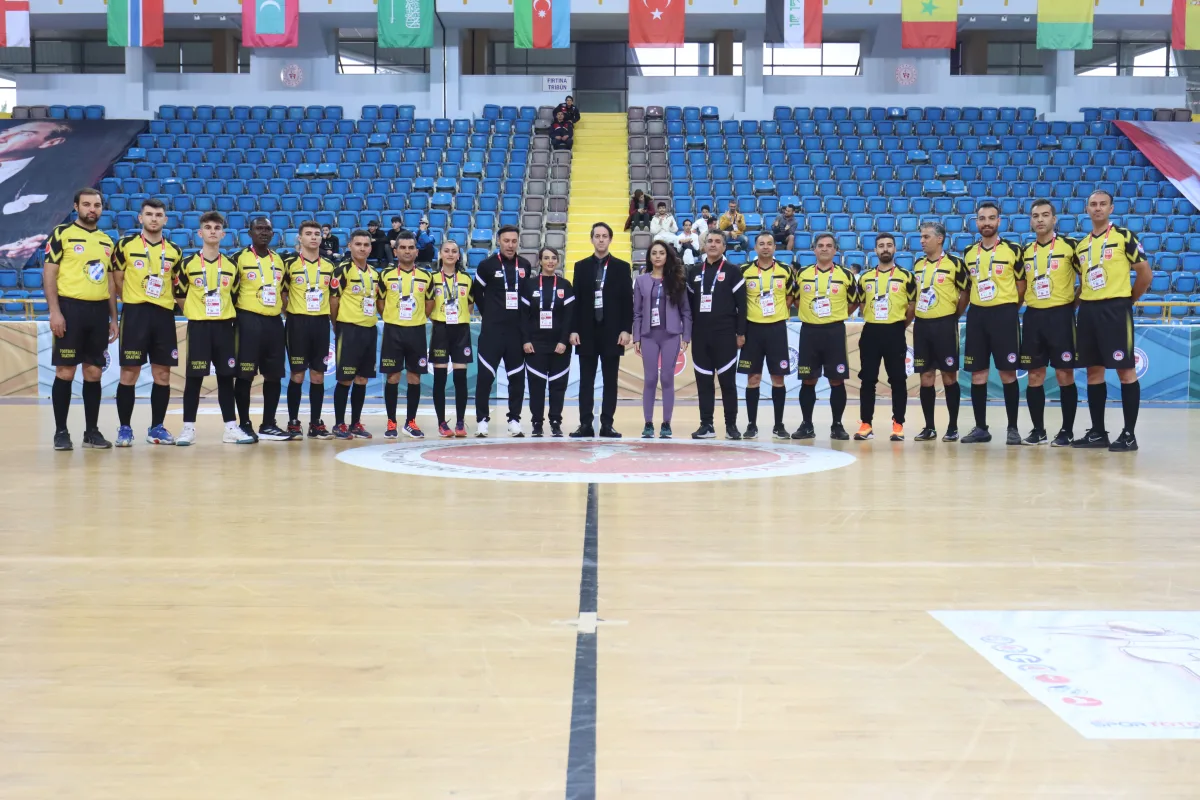
Each official FUTINS World Cup match shall normally be managed by six active match officials:
- Main Referee - positioned inside the court.
- First Second Referee - positioned inside the court along one longitudinal side wall.
- Second Second Referee - positioned inside the court along the opposite longitudinal side wall.
- Chief Referee - positioned at the right side of the Referee Table.
- Table Referee - positioned at the centre of the Referee Table.
- Time Referee / Timekeeper - positioned at the left side of the Referee Table.
The Main Referee and both Second Referees are all active on-court officials. The two Second Referees move lengthwise along the right and left sides of the court, close to the side walls, in order to provide continuous lateral coverage and observe incidents outside the Main Referee’s primary field of vision.
Each match shall also normally have three Reserve Referees available for replacement or emergency support. The complete refereeing team may therefore consist of six active officials and three reserve officials, for a total of nine appointed referees.
Equality, Coordination and Collective Responsibility
All appointed referees form one official match-management team. Each official has a defined position and specific responsibilities, but the success of the system depends on continuous communication, mutual professional respect, accurate observation, consistent application of the Laws and immediate reporting of relevant incidents.
The Main Referee and Table Referee hold central operational authority in their respective areas. The Main Referee controls play inside the court, while the Table Referee controls and records the official administrative, disciplinary and technical events of the match.
No official shall publicly contradict or undermine another member of the refereeing team. Where consultation is required, it shall be conducted professionally, quickly and, where possible, away from players and team officials.
Official Communication System
The Main Referee, both Second Referees and the Table Referee shall use the official FIFS referee signals, eye contact and an approved radio communication system, including official walkie-talkies or equivalent communication equipment supplied or authorized for the competition.
Radio communication is a supplementary tool. It does not replace correct positioning, visual awareness, the whistle or the official FIFS signals.
The approved radio system may be used for urgent, exceptional or out-of-view information, including:
- Serious incidents outside another referee’s field of vision.
- Player identification and mistaken identity prevention.
- Penalty encroachment or goalkeeper movement.
- Illegal substitutions.
- Bench misconduct.
- Unclear signals requiring immediate confirmation.
- Safety, medical or security concerns.
- Technical or timing irregularities.
Radio communication shall remain brief, factual, professional and directly related to match management. The Chief Referee and Time Referee may be included in the communication system where authorized by the competition’s technical setup.
The Main Referee
1 Position and General Authority
The Main Referee is the principal on-court official and performs duties inside the playing court. The Main Referee may officiate with or without skates, subject to appointment, surface conditions, safety requirements and demonstrated competence.
The authority of the Main Referee begins upon entry into the official competition area and continues until all post-match responsibilities have been completed.
2 Principal Duties
- Enforce the FUTINS Laws of the Game.
- Control, start, stop and restart the match.
- Award or disallow goals.
- Award direct and indirect free kicks.
- Award Short Penalties.
- Apply advantage where appropriate.
- Identify fouls and misconduct.
- Issue Yellow, Red and Black Cards within the authorized system.
- Communicate player numbers and sanctions to the Table Referee.
- Protect player safety.
- Consult other officials where necessary.
- Confirm the official end of each period and the match.
- Submit all required reports.
3 Match Control and Positioning
The Main Referee shall maintain a clear view of play, appropriate movement and positioning, safe distance from players and continuous awareness of the ball, players, goalkeeper, walls, Second Referees and Referee Table.
The Main Referee shall not interfere unnecessarily with the flow of play. Advantage may be applied where the non-offending team benefits and player safety and match control are not compromised.

4 Correction of Decisions
A decision may be corrected before play has restarted where the Main Referee recognizes an error or receives decisive information from another official. Once play has lawfully restarted, a factual decision should not normally be changed except to correct mistaken identity, a serious administrative error or another exceptional matter recognized by the Referees Committee.
The Two Second Referees
1 Position and Movement
Each match shall normally have two Second Referees inside the court. One moves along the right longitudinal side of the court and the other along the left longitudinal side, close to the side walls.
They move forward and backward along their assigned sides in coordination with the direction of play. Their positioning shall provide lateral coverage of both halves, goal areas, penalty procedures, substitution zones, wall-side incidents and events behind or outside the Main Referee’s primary view.
2 Primary Responsibilities
- Observe fouls not clearly seen by the Main Referee.
- Monitor incidents near the side walls and perimeter system.
- Observe goal-line and penalty-area incidents.
- Monitor illegal substitutions and early entry.
- Monitor bench conduct and substitution doors.
- Observe ceiling or overhead contact.
- Monitor goalkeeper movement during Short Penalties.
- Monitor player encroachment during penalty procedures.
- Report dangerous or serious conduct occurring behind the Main Referee.
3 Communication and Authority
Second Referees communicate through official signals, eye contact and the approved radio system. The official with the clearest view of an incident must provide accurate information immediately.
The precise whistle and card authority of each Second Referee shall be confirmed by the Referees Committee. An inexperienced or restricted Second Referee may be required to recommend certain sanctions rather than issue them directly.
4 Support Without Interference
Second Referees must actively support the match without creating unnecessary duplicate signals or conflicting decisions. They must distinguish between incidents requiring immediate intervention, incidents requiring information to the Main Referee and incidents that should simply be monitored.
The Chief Referee
1 Position and Appointment
The Chief Referee shall sit at the right side of the Referee Table with a clear view of the full court, the three on-court referees, the technical areas, substitution zones, scoreboard and timing system.
A Chief Referee shall be appointed for each match by FIFS, the FIFS Referees Committee or the authorized competition refereeing authority. The Chief Referee serves as the official technical representative of the Referees Committee for that match.
2 Principal Function
The principal duty of the Chief Referee is to monitor and evaluate the work of the appointed refereeing team.
- Application of the Laws.
- Positioning and movement.
- Fitness and readiness.
- Accuracy of decisions.
- Use of advantage.
- Disciplinary management.
- Communication between officials.
- Control of benches and substitutions.
- Correct use of official signals.
- Professional conduct and consistency.
3 Non-Interference Principle
The Chief Referee does not replace the Main Referee and shall not control ordinary factual decisions from the table. Intervention is justified only where there is a serious misapplication of the Laws, mistaken identity, a missed major disciplinary incident, an immediate safety or integrity concern, inability of an official to continue or another urgent procedural issue.
4 Assessment and Replacement
The Chief Referee shall prepare a confidential official performance report and may coordinate the emergency replacement of an active official with one of the Reserve Referees.
The Table Referee
1 Position and Status
The Table Referee shall sit in the centre position of the Referee Table. The Table Referee is a principal active match official and is not merely a secretary or scorekeeper.
2 Principal Responsibilities
- Complete the official FIFS Score Sheet.
- Verify team lists and player numbers.
- Record goals and goal scorers.
- Record own goals where applicable.
- Record Personal Fouls and Team Fouls.
- Record Yellow, Red and Black Cards.
- Record Short Penalties and Ball-Holding offences.
- Record time-outs.
- Monitor benches and technical areas.
- Communicate with the on-court officials through official signals and approved radio.
- Confirm match information with the Time Referee.
- Obtain required signatures after the match.
- Submit the official record to the authorized competition authority.
3 Team Fouls and Ball-Holding
The Table Referee shall display the Yellow Warning Flag for the fourth Team Foul and the Red Flag for the fifth Team Foul, together with the Short Penalty signal where required.
The third goalkeeper Ball-Holding offence results in a Personal Foul. The sixth results in a Personal Foul and a Short Penalty.
4 Bench Discipline
The Table Referee monitors substitutes, coaches, Team Managers, medical staff, media staff and other accredited officials. Team Officials outside the court may receive Yellow Cards and Black Cards but do not receive Red Cards under the current system.
5 Official Record
The Score Sheet is a legal and technical record. It must be accurate, legible, complete, updated in real time, signed as required and protected from unauthorized alteration.
The Time Referee / Timekeeper
1 Position and Responsibilities
The Time Referee shall sit at the left side of the Referee Table and is responsible for all official time-related functions.
- Operate the official match clock.
- Start and stop time on the authorized signal.
- Monitor each period and half-time.
- Monitor team time-outs.
- Monitor temporary exclusions.
- Record authorized stoppages.
- Manage countdown procedures.
- Assist with additional time.
- Communicate timing information.
- Confirm the official end of each period.
- Report timing irregularities immediately.
2 Time-Out and Delay Procedures
During a sixty-second time-out, the Time Referee starts the official time, begins the final ten-second countdown after fifty seconds and reports any team that is not ready to restart.
Unjustified delay may result in a Team Foul, an additional Team Foul, a Short Penalty or another sanction under the Laws.
3 Temporary Exclusions
The Time Referee monitors every three-minute Red Card exclusion. The excluded player may return only after the full period has expired and the Time Referee has confirmed eligibility to return.
Reserve Referees
Each World Cup match shall normally have three qualified and accredited Reserve Referees. They must be present, correctly dressed, physically ready, fully briefed and available until all duties are complete.
Reserve Referees may replace any active official who is injured, ill, technically unable to continue, removed by the authorized refereeing authority or otherwise unavailable for an exceptional reason.
The pre-match briefing shall define the replacement order. No Reserve Referee may enter an official role without authorization from the Chief Referee or Referees Committee.
Before replacement, the outgoing official shall, where possible, communicate the current score, cards, fouls, Ball-Holding count, time-outs, exclusions and unresolved incidents.
Referee Qualifications
All World Cup referees must hold an appropriate and valid FIFS/IPTC referee qualification.
- Minimum required certification level.
- Recent officiating experience.
- Completion of an updated Laws seminar.
- Written examination.
- Official referee-signal examination.
- Fitness test.
- Practical court assessment.
- Attendance at the pre-competition referee seminar.
- Ability to communicate in English or another approved working language.
- Medical fitness to officiate.
A referee who does not meet the required standard may be removed, reassigned, restricted to a reserve role or required to complete additional training.
Appointment, Neutrality and Conflict of Interest
Appointments shall be based on qualification, experience, performance, neutrality, physical fitness, technical competence, communication ability, previous assessments, match difficulty, nationality and conflict-of-interest considerations.
Participating teams may not select, approve or reject referees. No referee is guaranteed a specific number of matches.
Every referee must disclose any actual or potential conflict of interest, including nationality, employment, coaching, family, financial, club or personal relationships that may reasonably question impartiality.
Referee Uniform and Equipment
- Official referee shirt.
- Approved shorts or trousers.
- Matching socks.
- Approved footwear or skates.
- Whistle.
- Yellow, Red and Black Cards.
- Watch or timing device.
- Official radio communication equipment where assigned.
- Official referee badge.
- Writing materials.
- Required protective equipment.
The referee uniform must be clearly distinguishable from both teams and goalkeepers. Unauthorized sponsor logos, political messages, personal advertising and non-approved branding are prohibited.
Pre-Match Duties
- Attend the official referee briefing.
- Inspect the court, walls and perimeter system.
- Inspect goals, markings and penalty marks.
- Check the official Size 5.5 ball.
- Check scoreboard and timing equipment.
- Check the Referee Table, flags, cards and Score Sheet.
- Check substitution zones and doors.
- Test the official radio communication system.
- Confirm team colours and player equipment.
- Confirm Reserve Referee order.
- Review special competition instructions.
The match shall not start where the court, goals, walls, equipment, communication system or conditions present an unacceptable safety or technical risk.
Team-List, Identity and Eligibility Checks
The refereeing team and authorized competition officials may verify player identity, accreditation, jersey number, goalkeeper designation, Team Captain, technical staff, authorized bench personnel and suspensions.
No person may participate if not listed on the official Match Sheet, not properly accredited, suspended, wearing an unauthorized number, using prohibited equipment or otherwise declared ineligible.
Whistle, Signals and Advantage
All signals must follow the official FIFS visual standards. Improvised or unofficial signals shall not be used.
The whistle shall be used where necessary to start or stop play, signal fouls, confirm penalties, manage injuries, control misconduct and end a period or match.
Advantage may be applied where the non-offending team has an immediate and meaningful opportunity, provided safety and match control are preserved. Any required disciplinary card may be issued at the next stoppage.
Injury and Medical Intervention
Play shall be stopped immediately where serious injury, concussion, unconsciousness, significant bleeding or another urgent risk is suspected.
Medical staff may enter the court only when authorized, except in a clear life-threatening emergency. The authorized medical decision regarding safety and return to play must be respected.
Serious Misconduct and Spectator Behaviour
The referee team shall respond firmly to violent conduct, serious foul play, spitting, threats, discriminatory abuse, physical contact with officials, attempted assault, match manipulation, fraud, deliberate destruction of equipment and serious misconduct by Team Officials.
A direct Black Card may be issued where appropriate, and the incident must be included in the official report.
Where spectator behaviour threatens safety or match integrity, the referee team may stop or suspend play, request removal of an individual, move teams to a safe area or recommend abandonment.
Match Suspension and Abandonment
A match may be suspended or abandoned because of unsafe conditions, serious injury, security incidents, spectator disorder, refusal to play, insufficient eligible players, failure of essential equipment, major misconduct, force majeure or another threat to safety or integrity.
The referee report shall record the time, score, reason, cards, sanctions, actions taken and whether the match resumed. The Competition Committee determines the official result.
Half-Time and Post-Match Duties
At half-time, the officials shall confirm the score, cards, Team Fouls, Ball-Holding records, exclusions and unresolved incidents.
After the match, they shall confirm the final score and winner, complete and sign the Score Sheet, obtain required team confirmations, submit disciplinary and incident reports and attend any required post-match review.
No referee may leave before being released by the Chief Referee or authorized Referees Committee.
Referee Reports
A separate written report is required for a Black Card, serious misconduct, violence, threats, match abandonment, spectator removal, identity fraud, refusal to play, major injury, technical protest or another exceptional incident.
Reports must be factual, objective, clear, chronological and submitted within the official deadline. Unsupported assumptions and emotional or insulting language are prohibited.
Referee Independence and Prohibition on Team Contact
Referees must remain independent from all participating teams, players, coaches, federation officials and delegation members.
Referees shall not engage in private, social, commercial or unofficial communication with any team before, during or after the competition.
They shall not visit team hotels, accept team hospitality, attend private team events, exchange private contact details for competition-related purposes or discuss appointments, decisions, reports or internal matters.
Any necessary communication with a team must take place only through the official competition channels, authorized technical meetings, the Referee Table procedure, the Team Manager protocol or the designated FIFS/IPTC competition authority.
Separate Referee Accommodation and Protection System
At an official Football Skating World Cup, referees shall be accommodated in a dedicated Referee Hotel separate from the hotels used by athletes, teams, federation officials and other delegations.
The referee accommodation system shall include, where applicable:
- Dedicated and controlled referee accommodation.
- Referee-specific security procedures.
- Protected arrival and departure arrangements.
- Separate referee transportation services.
- Controlled access to referee areas.
- Separate meal and meeting arrangements where required.
- Dedicated referee media and communication procedures.
- Protection from unauthorized team, public or media contact.
- Emergency and incident-response protocols.
The Host Organizer, FIFS and IPTC shall coordinate reasonable measures to protect the independence, safety, privacy and professional working conditions of the refereeing team.
Teams and delegation members shall not enter the Referee Hotel, referee transport vehicles, referee meeting rooms or other protected referee areas without express authorization.
Confidentiality
- Appointments before official release.
- Internal referee discussions.
- Referee assessments.
- Disciplinary deliberations.
- Unpublished reports.
- Private team and medical information.
- Security and operational information.
- Radio communication content.
Score Sheets, internal videos, reports, radio recordings or private communications may not be disclosed without authorization.
Media and Social Media Conduct
Match officials shall not publicly criticize another referee, debate controversial decisions online, disclose confidential reports, reveal future appointments or publish content that damages neutrality or competition integrity.
Official interviews and referee media activities may take place only through the authorized FIFS or World Cup Media Department under the separate referee media protocol.
Gifts, Benefits and Improper Influence
Referees shall not accept money, valuable gifts, private hospitality, personal travel, commercial benefits or any advantage offered to influence or appear to influence a decision.
Any approach, threat, bribe or attempted influence must be reported immediately.
Professional Conduct
- Impartiality.
- Respect.
- Punctuality.
- Discipline.
- Appropriate language.
- Physical readiness.
- Professional appearance.
- Cooperation.
- Emotional control.
- Respect for cultural and national differences.
A referee must not officiate while impaired by alcohol, prohibited substances, illness, severe fatigue, medication affecting performance or any condition preventing safe and competent officiating.
Referee Performance Review and Education
Every World Cup referee may be assessed after each appointment. Assessment may consider knowledge of the Laws, decision accuracy, positioning, movement, fitness, signals, communication, match control, disciplinary management, cooperation, professional conduct and accuracy of reports.
The Referees Committee may organize daily meetings, video analysis, signal practice, fitness sessions, technical workshops, individual feedback, written tests and practical reassessment.
Based on performance, a referee may receive further appointments, be assigned to more difficult matches, be placed in a reserve role, receive corrective instruction, be removed from later appointments or be referred for retraining or disciplinary review.
Disciplinary Measures Against Match Officials
- Serious or repeated technical error.
- Misapplication of the Laws.
- Bias or failure to disclose a conflict.
- Falsification of a Score Sheet.
- Disclosure of confidential information.
- Abuse of authority.
- Improper contact with teams.
- Acceptance of gifts or benefits.
- Unprofessional media conduct.
- Failure to report serious incidents.
- Refusal to follow authorized instructions.
Possible measures include a verbal or written warning, removal from a match, removal from future appointments, suspension, demotion, mandatory retraining, withdrawal of international referee status or referral to the FIFS disciplinary authority.
Protests Concerning Refereeing
A team may not protest merely because it disagrees with a referee’s factual judgment during play.
A refereeing-related protest may be considered only where it concerns a clear misapplication of the Laws, mistaken identity, participation of an unauthorized official, serious procedural failure, manipulation, misconduct or another regulatory issue recognized by the Competition Committee.
Protection of Match Officials
FIFS, IPTC and the Host Organizer shall take reasonable measures to protect referees from threats, harassment, physical assault, unauthorized access, public intimidation and discriminatory abuse.
Any physical attack or serious threat against a referee shall be treated as a major disciplinary offence.
Working Language
The official working language of the international referee team shall be English unless FIFS approves another operational language.
All appointed referees must understand essential match instructions, official terminology, player numbers, cards, fouls, emergency instructions, radio communication procedures and Referee Table operations.
Technology and Video Review
Unless FIFS formally introduces an approved video-review system, match decisions shall be made by the appointed officials without unofficial video intervention.
Teams, broadcasters, spectators and private camera operators may not demand that a referee review personal or unofficial footage.
Where an official review system is introduced, FIFS shall issue separate regulations governing reviewable incidents, authority, communication, time limits, final decisions and technical failure.
Final Interpretation
FIFS retains final authority over the interpretation and application of these Refereeing Regulations.
The authorized FIFS Referees Committee may issue clarifications, technical instructions, temporary procedures, competition-specific directives and amendments required for safety or operational reasons.
All referees, teams and officials must comply with such instructions.
Refereeing Team Summary
| Position | Location | Principal Responsibility |
|---|---|---|
| Main Referee | Inside the court | Controls play and applies the Laws. |
| First Second Referee | Inside the court, along one side wall | Provides longitudinal and lateral coverage. |
| Second Second Referee | Inside the court, along the opposite side wall | Provides opposite-side coverage and observes unseen incidents. |
| Chief Referee | Right side of Referee Table | Monitors and evaluates the refereeing team. |
| Table Referee | Centre of Referee Table | Controls official records, fouls, cards, bench conduct and radio coordination. |
| Time Referee / Timekeeper | Left side of Referee Table | Controls match timing, countdowns and exclusions. |
Three Reserve Referees
Three qualified Reserve Referees shall remain available to replace active officials and preserve the continuity and integrity of the match.
Official Contact
Questions concerning international referee education, World Cup referee appointments and FUTINS refereeing requirements shall be directed through the official FIFS communication channels.
worldcup@footballskating.com
Official equipment
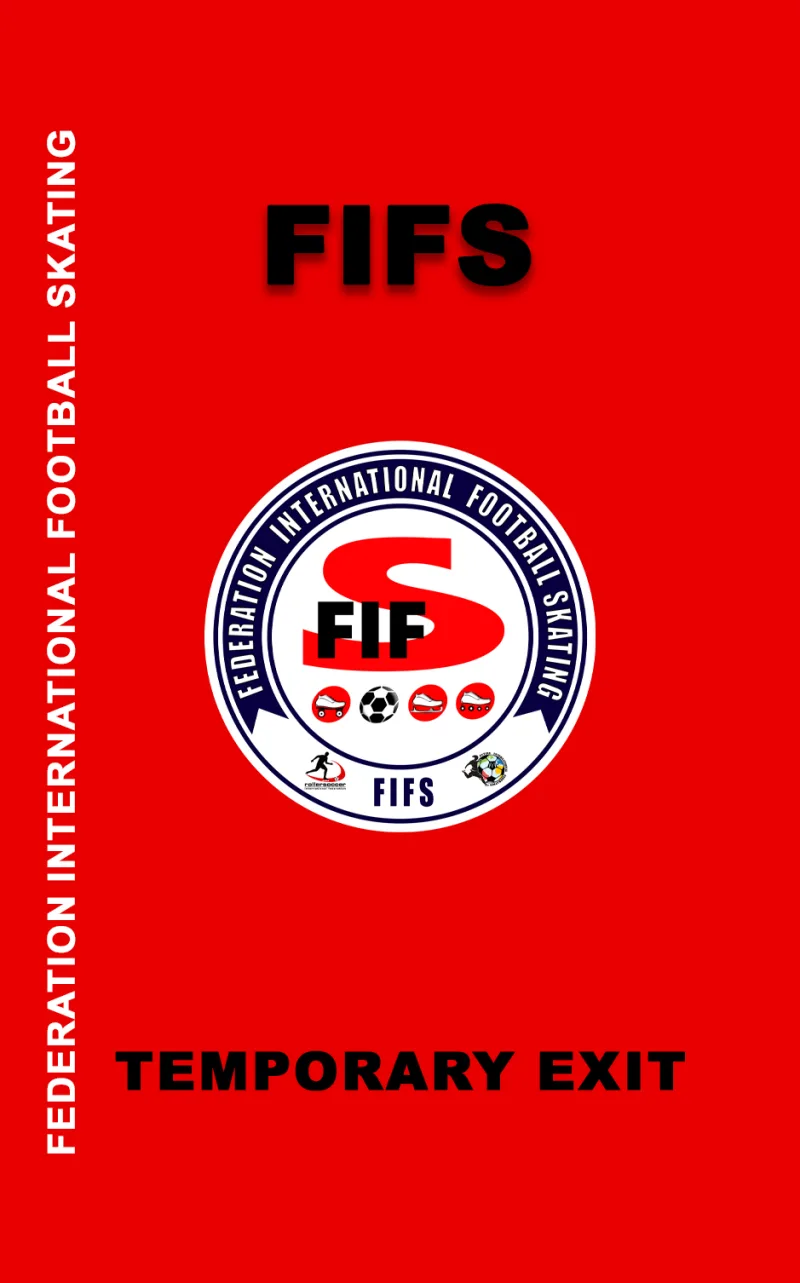
Official FIFS Referee Cards
The official Football Skating referee cards — yellow (warning), red (temporary exit) and black (permanent exit) — used by certified FIFS match officials.
Get involved
Connect with the world of Football Skating
FIFS welcomes official enquiries from national federations, clubs, schools, partners, event hosts, coaches and referees.